Which Recruitment Strategy Fits Your Business: Executive Search or Traditional Hiring?
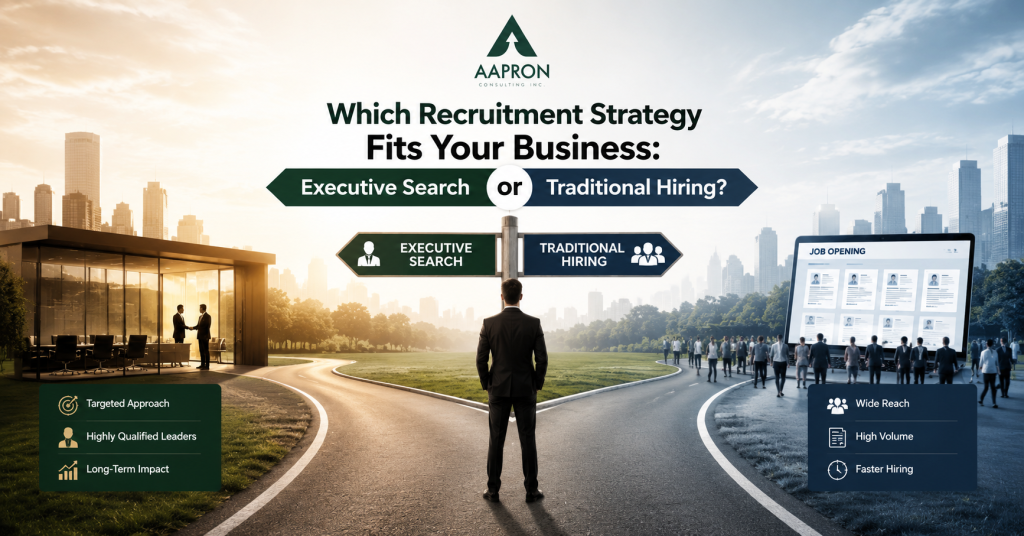
Hiring the wrong person is expensive. Most companies already know that, at least in theory. What they underestimate is how the cost actually shows up, months of disrupted work, a team that’s quietly demoralized, a second search that ends up costing more than the first one did, and everyone left wondering what went wrong in the first place.
Executive search and traditional recruitment solve two genuinely different problems. They run on different timelines, need different levels of involvement from the business hiring, and lean on different skills entirely on the recruiting side.
At Aapron Consulting, our work as a best hiring agency in USA covers a lot of ground, from filling a specialist role quickly to finding a leader for a position where getting it wrong would actually hurt the business. Every hiring situation looks a little different, and picking the right approach usually comes down to the role itself, the company, and the kind of person it needs sitting in that seat. That’s a conversation we end up having with clients constantly.
The Real Difference Between the Two
Traditional recruitment follows a fairly predictable path. Write the job description, post it, screen whoever applies, shortlist, interview, make an offer. The whole thing rests on an assumption: that the right candidate is somewhere in that applicant pool, or reachable through a database of people already looking.
Executive search starts from a completely different place. The strongest candidate for a senior leadership role is almost never actively job hunting. They’re employed, doing well, not scrolling job boards on a Tuesday afternoon. Finding that person means mapping out who’s actually in the relevant talent landscape, identifying specific people by name and reputation, and reaching out directly with a reason compelling enough to make them consider leaving a job they’re not unhappy in.
Different methodology. Different timeline. Different cost structure. And a genuinely different skill set on the recruiting side.
Where Traditional Recruitment Works Well
Traditional recruitment is a solid, well-proven process for a specific kind of hire. Knowing where it shines is really what tells you where it starts to fall short.
It performs best when the candidate pool is wide and reachable. For roles where plenty of qualified people are actively looking, traditional methods get through that pool efficiently. Mid-level tech roles, finance and operations positions, sales and marketing, specialist functions inside a scaling company, these are the areas where a well-written job posting and a structured screening process reliably turn up a strong shortlist.
Speed is the other clear advantage. When the requirements are well-defined and the market has decent supply, and the business needs to move quickly, traditional recruitment does that job well. A good recruiter here handles volume, judges fit efficiently, and doesn’t let strong candidates go cold while a decision drags on.
Traditional recruitment tends to work best when:
- The role sits at mid-level or below
- The candidate pool is broad and people in it are actively job hunting
- Speed matters more than an exhaustive search
- Confidentiality isn’t a major concern
- The requirements are already clear before the search even starts
What it isn’t built for: finding people who aren’t looking, assessing fit at the level of depth a senior role actually demands, or handling the kind of quiet, careful outreach that comes with hiring at the top.
Where Executive Search Earns Its Cost
Executive search exists to solve one particular problem. How do you hire for a role where the quality of the person matters enormously, and where the best candidates almost certainly aren’t going to apply on their own?
C-suite roles. Divisional heads. Function leads where a bad hire at the top creates problems that ripple through the whole business for years. Board seats. Country managers. Anyone whose decisions will shape where the company goes.
Confidentiality matters in a way it simply doesn’t for a junior hire. A company looking for a new CFO usually doesn’t want competitors, employees, or the current CFO catching wind of it. Executive search firms run these searches discreetly, something a public job posting can’t offer.
The evaluation gets deeper too. Someone at this level isn’t being judged on skills and years of experience alone. It comes down to how they lead under pressure, whether their approach actually fits the company’s culture at a strategic level, what they’ve delivered rather than how long they’ve been doing it, and how they operate across a room full of stakeholders with different priorities. Getting a real read on that takes competency-based interviews and references that go well beyond the names a candidate hands over themselves.
Executive search is usually the right call when:
- The role is VP level or above
- The strongest candidates almost certainly aren’t job hunting
- The search needs to stay confidential
- A bad hire would cause real, cascading disruption
- A genuine read on leadership quality matters more than speed
The timeline is longer by design here. A properly run executive search typically takes three to six months. Trying to compress that artificially almost always means giving something up, either the range of people considered or the rigor of how they’re assessed. Sometimes both.
Retained vs Contingency, and Why It Matters
Traditional recruitment usually runs on contingency. The agency only gets paid if a hire actually happens. That builds in an obvious incentive toward speed and toward candidates who are likely to get hired, which isn’t always the same thing as the best candidates. For the right kind of role, this isn’t a flaw. For a senior executive search, the incentives stop lining up quite as well.
Executive search is typically retained. Part of the fee is paid upfront, with the rest tied to milestones along the way. A useful way to think about the difference: a contingency recruiter gets paid to close a hire, a retained search partner gets paid to run a thorough, honest process. That structure buys the client dedicated attention, real market intelligence, and a recruiter whose interests actually point toward quality instead of just speed.
Here’s a real pattern worth mentioning. A technology company ran a contingency search for a new VP of Engineering and filled the role in eight weeks. The hire was gone within nine months. The retained search that followed took four months and cost more upfront, but the person hired stayed, performed well, and built a team that’s still largely intact two years later. Once everything got counted, the second search was actually the cheaper one.
Retained search isn’t the right structure for every hire. But for the right level and the right situation, it’s the one that produces outcomes worth trusting.
What Most Businesses Actually Face
A company scaling fast might need both, traditional recruitment to build out the team underneath, executive search for the director or VP who’ll lead it. A business entering a new market might use traditional methods for operational roles while running an executive search for the person leading that market entry.
As a leading recruitment firm in USA, Aapron Consulting runs both models side by side. Knowing which approach a given hire actually needs comes from working across enough different kinds of businesses, technology companies, healthcare organizations, financial institutions, engineering and construction firms, to understand where each method genuinely helps and where it just adds friction without changing the outcome.
Where Businesses Tend to Get This Wrong
Choosing based on budget instead of the role. Executive search costs more upfront, that part’s true. But it has to be weighed against what a bad senior hire actually costs. Research from organizations including the Society for Human Resource Management puts the total cost of a failed senior hire somewhere between one and three times that role’s annual salary once lost productivity, team disruption, severance, and a second search are all counted. Saving on the search fee and getting the hire wrong rarely comes out ahead in the end.
Defaulting to whatever worked last time. Companies that have always used contingency recruitment sometimes stick with it for senior roles purely out of habit. Companies used to retained search sometimes apply it to mid-level roles where it doesn’t actually add anything. The right method should follow the role, not precedent.
Underestimating how much sector knowledge matters. A recruiter who genuinely understands the industry, the relevant talent pool, and what the specific function is actually up against will consistently outperform one who doesn’t, regardless of which methodology is being used. This is one of the clearer practical advantages of working with a top hiring agency in USA that specializes in your sector, rather than a generalist spreading itself too thin to go deep anywhere.
How Aapron Consulting Approaches This
Working as a best staffing agency in USA, Aapron Consulting runs both traditional and executive search processes depending on what a role actually calls for, rather than defaulting to one method across the board. We’re not attached to one way of doing this. What matters is getting it right for the specific situation in front of us, which usually means an honest conversation about the role, the business, and what a good outcome actually looks like a year out, not just at the offer stage.
More often than hiring managers expect, the right approach isn’t obvious right away, and that’s fine. We work through it together before the search even starts. A finance director at a 150-person company needs a genuinely different kind of search than a CFO stepping into a business about to raise a Series C, even if the two roles land at a similar salary.
Getting that distinction right at the start is what saves a business from learning it the expensive way, after the hire’s already been made.
Final Thoughts
Executive search and traditional recruitment aren’t interchangeable. They solve different problems, at different levels of complexity, for different kinds of roles.
The quality of a hire matters. The quality of the process behind that hire matters just as much. As a leading recruitment firm in USA, Aapron Consulting has seen enough of both outcomes to know which investment tends to be worth making, and which shortcut usually ends up costing more than it saved.
If you’re weighing which approach fits your next hire, that’s exactly the kind of conversation worth having before the search starts, not after. Reach out to Aapron Consulting to talk it through.
Frequently Asked Questions
Q. Can a traditional recruiter run an executive search?
Some can, but the methodology and the relationship model are genuinely different. Executive search requires market mapping, direct outreach to people who aren’t job hunting, deep sector knowledge, and an assessment process well beyond a standard interview. Most contingency recruiters aren’t set up to run this kind of process, and few have the market relationships that make it work.
Q. How do I know if a role needs executive search?
If the position is VP level or above, manages a significant team or function, needs to stay confidential, or requires someone who almost certainly isn’t actively job hunting, executive search is usually the right call. Otherwise, traditional recruitment will typically get the job done.
Q. Is retained search always more expensive?
The fee structure is different, retained search involves an upfront payment plus milestone-based fees rather than a single fee on placement. The total cost is often higher, but it reflects a different level of process and commitment from the search firm. For senior roles where a wrong hire is costly, retained search economics tend to look considerably better in hindsight.
Q. How long should an executive search take?
Done properly, three to six months from the initial brief to an accepted offer. A search that’s compressed too far usually gives something up, either the range of candidates considered or the depth of assessment. Worth discussing upfront if speed is a real constraint.
Q. Does Aapron Consulting run both types of search?
Yes. We work across traditional recruitment and executive search, with sector knowledge spanning engineering and construction, healthcare, IT, and banking and finance across the USA. The method should follow the hire, not the other way around.